
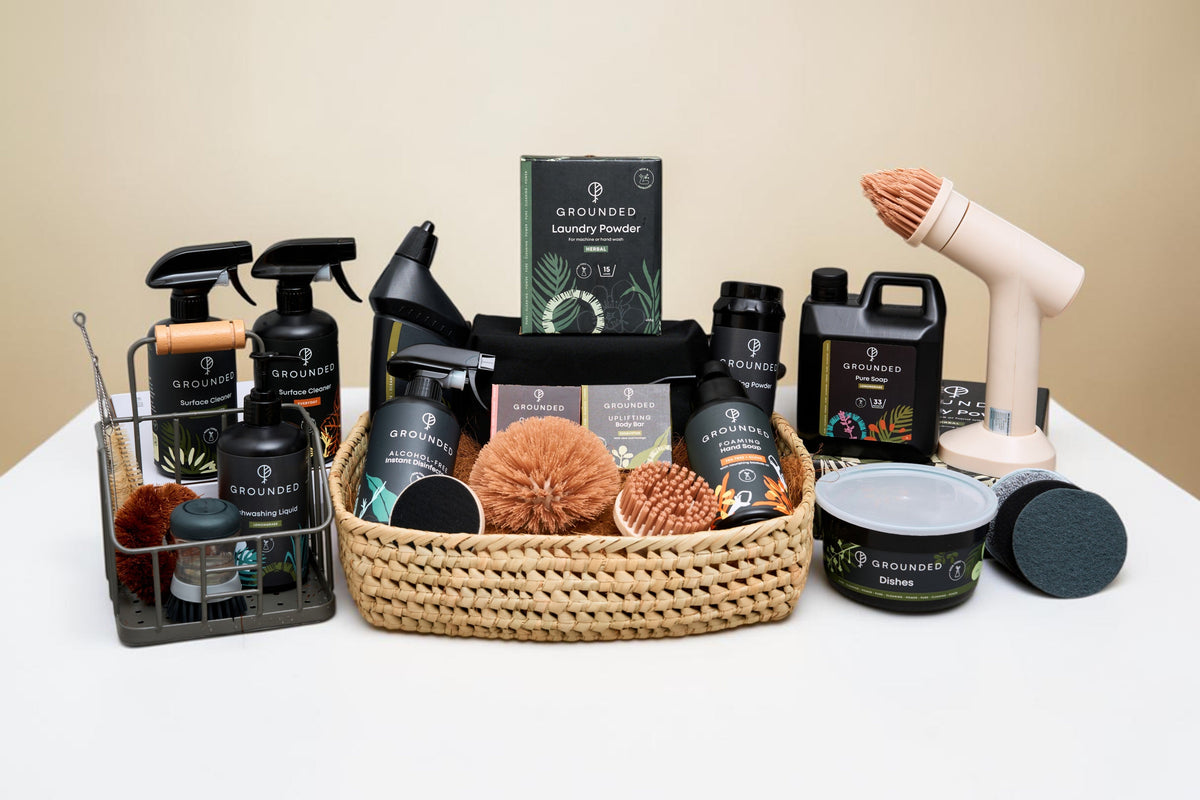
What Makes a Kitchen Truly Non-Toxic? A Guide to Choosing Better Products and Cleaning Them Safely
A joint edit from Grounded and Vitu Zote
If you've ever stood in front of a shelf of cleaning products squinting at the label trying to work out what "non-toxic" actually promises you, you're not alone. It's a genuinely confusing aisle.
That confusion is exactly why we're doing this together. Grounded has spent years figuring out what actually goes into a non-toxic clean, ingredient by ingredient. Vitu Zote has spent that same time figuring out what actually makes a kitchen tool worth keeping the materials, the design, the small decisions that mean a scourer or a dish rack earns its place on your sink for years instead of weeks. Put those two things together and you get something more useful than either brand could offer on its own: a full, honest picture of what a non-toxic kitchen actually looks like, from the tools in your hand to the products in the bottle.
What "non-toxic" actually means
Here's the honest answer: "non-toxic" isn't a term with a single legal definition, which is exactly why it gets stretched to cover almost anything with a leaf on the label. It's more useful to think of it as a set of qualities than a single checkbox. Does the product disclose everything it contains, avoid ingredients known to irritate skin and airways, and break down safely once it's rinsed away? A genuinely non-toxic product ticks those boxes. It's a spectrum, not a switch, and the goal isn't chasing perfection, it's cutting out the ingredients your kitchen never needed in the first place.
This is also where greenwashing in cleaning products creeps in. Plenty of bottles lean on green packaging and words like "natural" or "eco" without any obligation to prove it. Independent resources like EWG's Guide to Healthy Cleaning exist precisely because so many labels don't tell you what's actually inside.
How to read cleaning product labels
You don't need a chemistry background to shop smarter, just a habit of checking a few things:
- Full ingredient disclosure. A brand confident in its formula will tell you everything that's in the bottle. Vague terms like unspecified "fragrance" are worth a second look.
- Real soap over synthetic detergent. Soap made by saponifying plant oils has been cleaning effectively for thousands of years, and it biodegrades the way it's meant to.
- Known irritants to watch for. Sodium Lauryl Sulfate (SLS), synthetic fragrance, and chlorine bleach are common causes of dry hands, mild rashes, or that tight-chest feeling after a big clean.
- VOC-free formulas. Volatile organic compounds evaporate into the air as you spray, which is part of why a strong-smelling cleaner can leave a room feeling stuffy long after you've finished. Choosing VOC-free cleaning products matters most in smaller, less ventilated kitchens, which describes a lot of Kenyan homes. The EPA's Safer Choice programme is a useful reference point for what "restricted VOC content" actually looks like in practice.
Cleaning, sanitising and disinfecting aren't the same thing
This is one of the most misunderstood areas of household cleaning, and getting it right actually changes how you should approach your kitchen routine.
- Cleaning removes visible dirt, grease, and food residue using soap and water. It doesn't necessarily kill every germ, but by physically lifting dirt away, it removes most of them along with it. This is what the bulk of your everyday kitchen routine actually is.
- Sanitizing reduces germs to a level considered safe by public health standards, a meaningful reduction, but not a full kill.
- Disinfecting kills a specific, higher percentage of bacteria and viruses, and it's achieved with regulated agents used at set concentrations and contact times, think Grounded's Instant Disinfectant, alcohol-free and perfect for a multitude of uses, this all-purpose disinfectant effectively kills 99.99% of germs in 3 seconds or less. Bonus, it is entirely odorless and completely skin-safe.
For most day-to-day kitchen tasks, wiping counters, washing dishes, mopping, thorough cleaning is genuinely what matters most, and plant-based, non-toxic products handle that well. Disinfecting is the occasional, specific step on top.
Why this matters in your everyday routine
The kitchen sees more repeated, close contact than any other room.Hands on counters, steam carrying residue into the air, dishes going straight to your mouth. A few reasons safer formulations matter most here specifically:
- Kitchen surfaces get touched multiple times a day, every day
- Children are more sensitive to airborne and residue-based irritants than adults are
- Food-contact surfaces carry whatever's left behind on them straight onto your next meal
- Many Kenyan kitchens have limited ventilation, so fumes from harsh sprays linger longer than you'd expect
Swapping the products you reach for most, dish soap, surface spray, produce wash, is where the effort pays off fastest.
How cleaning products interact with your surfaces
Non-toxic doesn't mean weaker, but it does mean the right product for the right surface matters a bit more.
- Wood surfaces prefer gentle, non-abrasive cleaning. A soap-based formula like Grounded’s Surface Cleaner Everyday lifts grease without drying out or damaging the wood the way solvents and detergents can.
- Tile and stone (surfaces and floors) generally handle a citrus-based degreaser well, though acidic ingredients need a lighter touch on natural stone like marble, which can etch. Citrus Concentrate cuts through grease, deodorizes naturally, and leaves surfaces spotless without synthetic fragrances or harsh chemicals
- Stainless steel does best with a cleaner that cuts grease without leaving a residue film streaking is usually leftover product, not a lack of cleaning power.Grounded’s Surface Cleaner Extra Strength a powerful, soap-based all-purpose cleaner is designed to cut through grime and remove germstakes on tough messes and stubborn grease.
- Plastic containers and dishware are where harsh detergents most often leave residue that ends up back on your food, one reason a natural degreaser that’s kind to your hands like Grounded’s Solid Dish Soap and Grounded's Dishwashing Liquid is worth having on hand for everyday dish washing.
A good rule of thumb: if a product needs gloves and a warning label just to use safely, ask whether your kitchen surfaces really need that much chemical intensity in the first place.
Common misconceptions worth clearing up
"Natural" automatically means safe. Not quite, plenty of naturally occurring substances irritate skin or airways just as much as synthetic ones. The formulation is what matters, not just where the ingredients came from.
Non-toxic products won't cut it against real mess.Soap-based, plant-derived formulas cut grease and lift grime just as effectively, the cleaning power comes from the lathering/agitation, not from how harsh a product feels on your skin.
Foam equals clean but chemically speaking, foam is a useless by-product. More foam isn’t a better clean, it's more skin irritation. And manufacturers hide these harsh formulas behind "trade secrets" so we can't even evaluate the risks. They hide behind vague terms like 'fragrance' or 'cleaning agents,' but once we unpack those labels, it's much easier to opt for simpler, cleaner alternatives.
If it smells strong, it's working, wrong! Scent is often the opposite of a safety signal. A powerful chemical smell usually means synthetic fragrance or solvent not better performance. A citrus-based cleaner works through natural compounds like limonene; the scent is a side effect, not the active ingredient doing the work.
A Checklist of Swaps (Vitu Zote x Grounded)
You don't need to change everything at once. Start with what you reach for most, and work outward from there.
- Plastic scourer →Natural elements Coconut fibre scourer - tougher on grease, gentler on non-stick coatings
- Damp sponge →Masterclass non-scratch bristles dish brush - dries fully between uses, so bacteria has less chance to build up
- Dishes piled in the sink → a proper Kitchen Craft metal dish drainer or Living Nostalgia Wire Sink Tidy - better airflow, faster drying, fewer odours
- Liquid detergent → Grounded Solid Dish Soap - plastic-free, and one bar lasts months
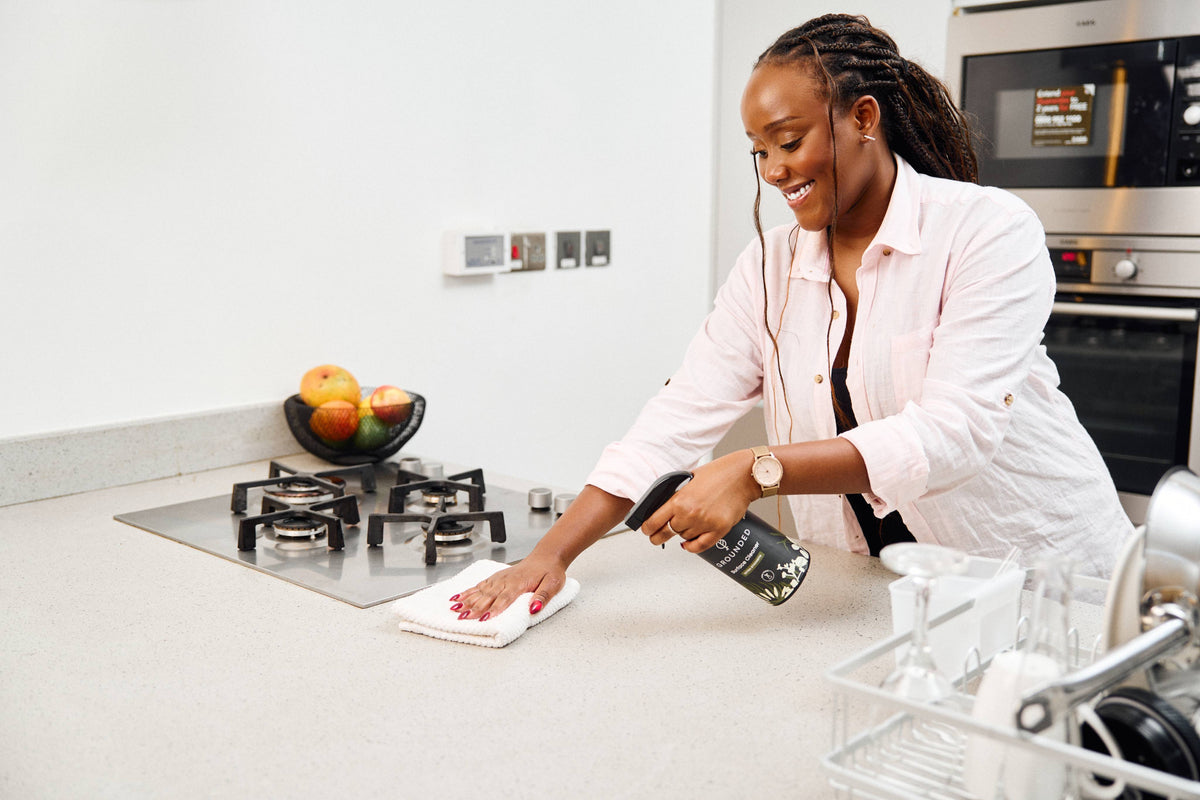
- Synthetic all-purpose spray → Grounded Surface Cleaner - citrus-powered degreasing without the harsh fumes
Small swaps, made in the right order, add up to a kitchen that's easier to keep clean and safer to cook in!


Leave a comment
This site is protected by hCaptcha and the hCaptcha Privacy Policy and Terms of Service apply.